Five AI will develop photorealistic simulation technology for faster and safer autonomous vehicle development
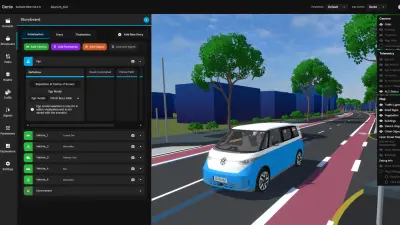
- Testing autonomous vehicles in the real world is costly and slow. This new simulation tool will make testing faster, safer, and less expensive.
- Five AI is a UK-based artificial intelligence and automated vehicle technology provider and it will develop the simulation tool in Cambridge.
- Five AI is wholly owned by leading mobility supplier Bosch.
Cambridge, UK – Five AI will develop a new type of simulation technology that will enable automotive manufacturers and their partners to develop the next generation of autonomous vehicles in a way that is safer, faster, and less expensive.
Five has secured UK Government funding through CAM Pathfinder to develop the technology. The company has been creating and using simulation software for automotive manufacturers since 2015. This new technology combines Gaussian scene reconstruction and generative AI techniques to create highly realistic digital representations of real-world environments.
Gaussian scene reconstruction converts images captured from the real world into photorealistic 3D environments that can be rendered efficiently in a simulation. It allows developers to recreate roads, junctions and other driving environments with a level of realism that was previously difficult to achieve at scale.
The project will also apply diffusion-based AI models to modify and enrich these digital environments. This enables the rapid generation of variations in lighting, weather and other scene conditions, allowing autonomous vehicle systems to be tested across a much wider range of scenarios than could be collected manually.
Many cars on the road today use Level 2 driver assistance, which is when the car can control the steering and the speed but the driver must remain alert at all times. Level 3 is also available in some cars. This new technology that Five AI is developing will be used to develop technology for cars that will use Level 2++ and Level 3 automation. Five’s simulation tool will work with others within Bosch Mobility to create a comprehensive platform. As well as Gaussian scene reconstruction and diffusion, it will use state of the art artificial intelligence to reconstruct photorealistic digital twins of the world. It will be possible to create scenarios and evaluate how the car handles them and ultimately the simulation will be able to train and validate L4 autonomous vehicle systems.
The project is part of the UK Government’s £150 million CAM Pathfinder programme, delivered by the Department for Business, Innovation, Science and Trade in partnership with Zenzic and Innovate UK. All UK Government grant funding is subject to HMG approval.
Dave Buffey, Head of Bosch Mobility UK, said: “This testing software will be an important cutting-edge innovation that will be developed by Five AI’s team. Our strategy is to work closely with Five to solve the complex challenges that our car manufacturer partners are tackling as they incorporate the latest autonomous driving tech into their vehicles. This is one of the biggest challenges in today’s automotive industry.”
Five AI is based in Cambridge in the UK and was acquired by Robert Bosch GmbH, a leading supplier of technology and services, in 2022.
About Five AI
Five AI, a Bosch company, is a UK-based artificial intelligence and automated vehicle technology provider. The team develops advanced simulation, validation and automated driving technologies that support the safe deployment of next-generation mobility systems. Based in Cambridge, Five AI combines expertise in AI, simulation and autonomous systems, working with leading automotive partners to accelerate innovation in automated driving.
About Zenzic
Zenzic is the UK’s trusted focal point and champion for connected and automated mobility (CAM), bringing together industry, government and academia to enable the development, deployment and commercialisation of CAM technologies and services. Established in 2017 and jointly funded by the UK Government and automotive industry, Zenzic works to ensure CAM innovation supports national priorities, economic growth and the future of safer, smarter and more sustainable mobility. Through a coordinated programme of insight, innovation, and collaboration, Zenzic is helping build the foundations of a commercially viable CAM market while strengthening the UK’s industrial capability and global competitiveness in the sector. Launched in October 2025 and delivered by the Department for Business, Innovation, Science and Trade (BIST) in partnership with Zenzic and Innovate UK, CAM Pathfinder is a key part of the UK Government's Advanced Manufacturing Sector Plan. Backed by up to £150 million of government funding through to 2030, the programme supports businesses to develop, demonstrate and scale commercially viable CAM solutions across the UK.
Press contact
Basic information
About Bosch
The Bosch Group established its first location outside its home market of Germany in London, England in 1898. Since then, Bosch UK and Ireland has become the company’s fourth largest region, behind Germany, China and the USA. As of December 31st, 2025, the company employs more than 6,000 associates in 30 locations across the UK and Ireland, including design and manufacturing facilities at Worcester Bosch in England and Bosch Rexroth in Scotland. Bosch also has an advanced automotive research and development centre in Limerick, Ireland. ETAS Limited’s office in York, England hosts the ETAS Group Centre of Excellence for Embedded Software Development.
The Bosch Group is a leading global supplier of technology and services. It employs roughly 413,000 associates worldwide (as of December 31, 2025). The company generated sales of 91 billion euros in 2025. Its operations are divided into four business sectors: Mobility, Industrial Technology, Consumer Goods, and Energy and Building Technology. With its business activities, the company aims to use technology to help shape universal trends such as automation, digitalization, electrification, and artificial intelligence. In this context, Bosch’s broad diversification across regions and industries strengthens its innovativeness and robustness. Bosch uses its proven expertise in hardware, software, and services to offer customers cross-domain solutions from a single source. It also applies its expertise in connectivity and artificial intelligence in order to develop and manufacture intelligent, user-friendly products. With technology that is “Invented for life,” Bosch wants to help improve quality of life.
The Bosch Group comprises Robert Bosch GmbH and its roughly 500 subsidiary and regional companies in over 60 countries. Including sales and service partners, Bosch’s global manufacturing, engineering, and sales network covers nearly every country in the world. Bosch’s innovative strength is key to the company’s further development. Bosch employs some 82,000 associates in research and development.
The company was set up in Stuttgart in 1886 by Robert Bosch (1861-1942) as “Workshop for Precision Mechanics and Electrical Engineering.” The special ownership structure of Robert Bosch GmbH guarantees the entrepreneurial freedom of the Bosch Group, making it possible for the company to plan over the long term and to undertake significant upfront investments in the safeguarding of its future. Ninety-four percent of the share capital of Robert Bosch GmbH is held by Robert Bosch Stiftung GmbH, a limited liability company with a charitable purpose. The remaining shares are held by Robert Bosch GmbH and by a company owned by the Bosch family. The majority of voting rights are held by Robert Bosch Industrietreuhand KG. It is entrusted with the task of safeguarding the company’s long-term existence and in particular its financial independence – in line with the mission handed down in the will of the company’s founder, Robert Bosch.
Additional information is available online at www.bosch-press.com.